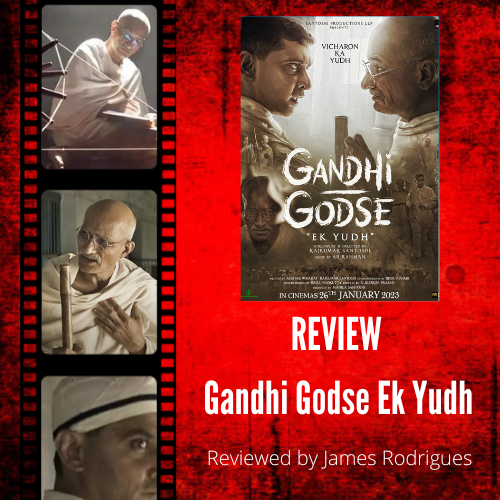
Opening in 1949, on-screen text describes India as a nation that was free yet torn. Carnage unfolds in the wake of India’s partition, as people are massacred in slow-motion while the surroundings are engulfed in flames. Mahatma Gandhu (Deepak Antani) wishes to build bridges between the warring people, yet discovers his own people distrust him. Meanwhile, Nathuram Godse (Chinmay Mandlekar) begins planning Gandhi’s assassination under the belief he’s responsible for the partition.
Based on a play of the same name, co-writer/director Rajkumar Santoshi adapts this fictional story which takes an alternative approach to history. After surviving his attack, Gandhi meets Godse face-to-face in prison to understand why, in a story described as a fictional narrative between two men and their ideologies.
There’s potential to question these two historical figures and their duelling beliefs, yet the story approaches it too simplistically. Santoshi and co-writer Asghar Wajahat barely scratch the surface with India’s partition and the horrific mistreatment of people, instead following a repetitive cycle where Godse lists his grievances and Gandhi gives a history lesson to prove the opposing man wrong. Considering how explosively Godse dislikes the man he sees as a “puppetmaster”, the conflict is wrapped up far too neatly.
Despite this being the films main selling point, the focus is oddly diverted to bizarre subplots. Gandhi’s brush with death encourages this iteration to try harder with helping people, striving for equality where all get justice and respect. This leads to him travelling from place to place, solving problems as though he’s a non-violent superhero that protects the trees and rescues kidnapped girls. Another subplot follows a couple that wish to help Gandhi’s mission, feeling inspired by Nicholas Sparks and feeling out of place whenever it pops up.
While all this is happening, the higher-class people wish to protect their way of life and hire an assassin. As he looms over Gandhi, the filmmakers want to instil jeopardy yet instead have a recurring segment that feels forced and laughable. As the assassin repeatedly finds his opportunity to finish things squandered, it resembles Charlie Brown trying to kick the football. The clashing tones are too distracting, as the plot bounces all over the place until the eye-rolling resolution. The performances certainly fit the film, particularly in the titular roles, although there’s little to recommend here.
Rating: 1.5/5
Based on a play of the same name, co-writer/director Rajkumar Santoshi adapts this fictional story which takes an alternative approach to history. After surviving his attack, Gandhi meets Godse face-to-face in prison to understand why, in a story described as a fictional narrative between two men and their ideologies.
There’s potential to question these two historical figures and their duelling beliefs, yet the story approaches it too simplistically. Santoshi and co-writer Asghar Wajahat barely scratch the surface with India’s partition and the horrific mistreatment of people, instead following a repetitive cycle where Godse lists his grievances and Gandhi gives a history lesson to prove the opposing man wrong. Considering how explosively Godse dislikes the man he sees as a “puppetmaster”, the conflict is wrapped up far too neatly.
Despite this being the films main selling point, the focus is oddly diverted to bizarre subplots. Gandhi’s brush with death encourages this iteration to try harder with helping people, striving for equality where all get justice and respect. This leads to him travelling from place to place, solving problems as though he’s a non-violent superhero that protects the trees and rescues kidnapped girls. Another subplot follows a couple that wish to help Gandhi’s mission, feeling inspired by Nicholas Sparks and feeling out of place whenever it pops up.
While all this is happening, the higher-class people wish to protect their way of life and hire an assassin. As he looms over Gandhi, the filmmakers want to instil jeopardy yet instead have a recurring segment that feels forced and laughable. As the assassin repeatedly finds his opportunity to finish things squandered, it resembles Charlie Brown trying to kick the football. The clashing tones are too distracting, as the plot bounces all over the place until the eye-rolling resolution. The performances certainly fit the film, particularly in the titular roles, although there’s little to recommend here.
Rating: 1.5/5

 RSS Feed
